20.2.26

All kinds of blue


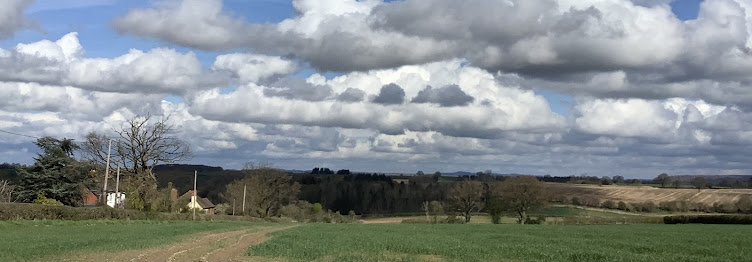
It was below freezing when I got up early last Saturday morning at 6.30 for a hot chocolate. When I returned to bed, the sun was just rising after 7, the crows were calling and I snuggled under the duvet and blanket for an indulgent lie in. When I woke later, the back field was covered in a dusting of frost and the sun was out for the first time in what feels like forever. I had almost forgotten that the sky was blue, not a dingy, cold grey, with what has felt like unending rain.


As my long term aim is to be painting properly again, I have been sorting out my watercolour tubes, some of which I’ve had for over 30 years. I’ve been painting up new samples of what I have, so that I have a visual reference to help my poor memory. About 25 years ago, when I was painting regularly, I instinctively knew, through long practise, what to mix up for the exact colour I needed. Now I accept that I need to be able to see exactly what is in each tube. Which oddly is what made needle felting so accessible for me; I had all the wool colours to hand, in clear bags and it made it so much easier to create  exactly what I had in mind. Knowing how my ADHD affects me, this makes perfect sense; if it isn’t in front of my nose, I won’t remember it. 


The front room was bitterly cold, but I got the wood burner going and began a sheet of blues, to go with the greens I painted up the week before.


The morning music was provided by Midlake - one of my favourite bands, but who have been off limits for years. These two CDs were part of the musical backdrop to our move to Shropshire; Andy discovered them and we both loved them. They reminded me too vividly of that last, happier life. I have my therapist to thank for encouraging me to face things like this, and now I can dance around the room to ‘Roscoe’ with crying. Although I did cry the first time. Another thing reclaimed, and music which brings me such joy and inspiration. 


One of the blues I was sampling was a generous present from a kind friend, and it’s the most expensive paint I own; Sleeping Beauty Turquoise by Daniel Smith. It actually cost more than I spend per week on food. It is made from pure pigment, from a mine in Arizona, hence the price, and is the most perfect turquoise I have ever seen. 


I’d been trying (unsuccessfully) to capture this exact shade for a new hare decoration. As you can see here, in these two first drafts, it wasn’t working at all. 


It’s a little like Daniel Smiths’s Cobalt Turquoise, but is just a smidgen more subdued, with an exquisite, subtle dullness. I have yearned for this colour ever since discovering its existence and I feel very lucky to own my own tube of it now.


Although the fire made the room bearable, it was still cold enough that I was chilled through by the time I’d finished. Happily, I had a pot of bean and vegetable soup ready, with a new batch of bread rolls. Time for a hot water bottle, bed, and an afternoon nap. 


3.2.26

Cooking for the future


I was glad to get this January out of the way - it was the 13th anniversary of losing Andy, and while it doesn’t hurt as it used to, I still felt lighter once the 21st was out of the way. This January was also packed with lots of work in my role as an ‘expert by experience’ trying to make up for a lack of hours in December. I’ve taken part in all day interview panels, role playing with interviewees and several Teams meetings from home, followed by the inevitable need for recovery time afterwards. With the delightful combination of ADHD and autism, I get social exhaustion very easily and my work is often intense, leaving me utterly drained. There are days where I’ve only been able to lie in bed, napping and listening to podcasts, while my ever busy brain rages that I should be doing something productive. Needle felting! Painting! Blogging! Cycling! All of it, all at once! But I can’t. I simply have to rest and recover, and be completely, blissfully alone.

Once I’d recovered from my last work session, I spent three days batch cooking for when I can’t face making a meal, or when I am in the office all day and only just have enough energy left to put something quick in the oven before crawling into bed. 

I’ve never been into fast or ultra processed food; I can remember at the age of 15, spending my babysitting money at the local health food shop. I had to buy my own granary loaf there, as my foster family only ate white sliced bread and were, to say the least, suspicious and resentful that I preferred to buy my own food and be a vegetarian. As well as reading books, a special crime in itself, earning me much ridicule. Which is one of the reasons I left after my 16th birthday and had to learn to survive on my own, on next to nothing. But I am wandering off topic, and it was a  very long time ago. 


I only became aware of the phrase ‘cooking from scratch’ last year, and was confused, as I have always followed (another catchphrase) ‘clean eating’ by choice and to me, cooking is just - well, cooking. I have had to economise throughout my life and I can cheaply batch cook something healthy for under £3, which can be turned into several meals for the freezer. Incidentally, I have only recently discovered baking a whole tray of potatoes at once, which can then be frozen for warming through when needed - how did I not know this before? They were a  godsend when the power was off a few weeks ago, and I was able to put a couple of them on the fire.

I steamed, cooked and baked, producing a large red lentil and sweet potato traybake, thickened with porridge oats and made delicious with extra veg, various seasonings and lots of garlic. Also, a pot of rich, earthy mushroom and brown lentil soup, a batch of plain bread rolls, a big bag of mirepoix, for quick soups and sauces, extra chopped celery, onions, carrots and leeks to freeze. I peeled and steamed a bag of white potatoes and used little kitchen scissors to cut a 1kg pack of cheap smoked bacon offcuts into tiny cubes, as a substitute for pancetta, for soups and risottos. 


I then made a crustless quiche with a base layer of potato slices, cheese, frozen  spinach, 5 eggs and various bits and bobs, and a jar of pickled carrots which are good to go in soups and salads. Finally, I made soup stock from all the vegetable peelings and gnarly bits.

I was all out of executive function by the time I was finally finished, and needed another rest day. But I was pleased to have a fully stocked freezer, for the days when I have zero energy. I live far from any shops, without a car and  I don’t have the option of ‘just popping out for something’. Fun fact; I haven’t had a takeaway meal for ten years. (This last fact has amazed my colleagues at work). 

February and snowdrop season should be lighter in many ways, and I aim to get a lot more of my own work done, as I plan new things for the future. 


11.1.26

Hunkered down


Shropshire unusually made the national news his week, as the Midlands took an overnight battering during Storm Goretti. Just after 10pm on Thursday night, there was a local power cut, then the snow arrived - brief but heavy, and fierce winds. The temperature has been barely above  freezing for days, so I huddled under my quilt and blankets, trying to sleep and hoping to find the power back on when I surfaced in the morning.

It hadn’t. So the first thing to do was to get the fire going. The cold was a nuisance, but as I don’t have central heating I am quite used to being a little chilly. Of course, the first thing to do was to boil some water for some much needed coffee. I sacrificed a little old enamel pan to the glowing coals, deciding to worry about the soot stains later. 


So with a fire going steadily and a hot drink inside me, I popped out to see how Jean and Brian-next-door were doing. They had a fire going that put my frugal effort to shame and were cheerfully getting on with things. Another neighbour called while I was there, to check in and make sure we were all ok and had the means to heat water and enough food. There aren’t many households here, so we stick together at times like this. Thankfully, phones were just about working, so many of us were chatting over WhatsApp. As far as we knew, we might not be reconnected until Saturday or even Sunday night.


I had cooked a tray of baked potatoes the night before, so I wrapped a couple in foil and left them to one side of the fire, to heat through for lunch, while I went out for a little walk and to visit another neighbour. What happiness, to return to hot potatoes, adding butter, sea salt and a little cracked black pepper for a simple feast. 


Later, I unearthed a futon mattress and made up camp in front of the wood burner. My main concern was occupying myself while the light was poor and dwindling. Full of buttery potatoes, I had a nap and then spent a couple of hours working with my sketch book until late afternoon, when I could barely see. I had a couple of candles, but nothing that would give me enough light to read or work by properly. Then my phone started bleeping with jubilant messages; a nearby village had been reconnected and soon our individual households were restored, to much rejoicing and relief. 


In the end I decided to stay downstairs by the fire for the night, as upstairs the cottage felt like a fridge; during the really cold weather, I leave a portable heater on in my bedroom. It’s set very low, so as not to use too much electric, but enough to take the edge off the chill. With a hot water bottle, this gets me through the winter. But I decided I would sacrifice comfort for warmth on this night. And indeed, my back was aching in the morning, after a restless sleep, on a thin mattress on top of hard quarry tiles. But oh, the pleasure in being able to boil the kettle for the all important first drink of the day, drinking it by the fire, while being watched by the robin as it peered curiously into my ramshackle home. 


23.10.25

A town for all seasons


English Bridge, seen leading out of Shrewsbury

The River Severn winds, snake-like around Shrewsbury in a large loop which  almost encircles it, so that from above it has the appearance of an island. It’s easy to see how this made such a seemingly modest town so desirable in times of trouble between Wales and England over the ages.

It has been, in its time, part of Wales and then part of England. Originally, it was thought to be the capital of the Welsh kingdom of Powys, and was called Pengwern (meaning ‘hill of alders’ or ‘swamp’ in Welsh), before being annexed in the late 8th century by the Anglo-Saxon kingdom of Mercia and becoming English. Situated so near to the Welsh border, it was a valuable asset to both sides, particularly when these two countries were at war in the 13th - 15th centuries. Well placed for trade, with a thriving population and large working Abbey, it had excellent defences  and all round access for barges and boats

The River Severn seen from English Bridge

Occasionally I am at work for a whole day, and as I am near one of the two major bridges which go in and out of Shrewsbury (there is one on either sides of town, the other being Welsh Bridge), I like to wander down in my lunch break to admire the river at English Bridge. (Locally it is always called  ‘English Bridge’, not ‘the English Bridge’). It looks beautiful all year round, but especially when it is flowing so gently that it barely seems to move and the surface reflects a soft mirror image of the river bank.

Towards Coleham from English Bridge

On a still, autumn day in the 21st century, the town is still active and busy, but the transport is now motor vehicles and the trade is very much the same as other medium sized English towns. Although there is, thankfully, no longer a McDonald’s in the centre - you have to drive to the outskirts for that. Better still, visit one of the many independent eateries or smaller food chains, and support a local business. 

Barracks Passage, leading to the Henry Tudor Inn, parts dating back to the 1420s

The other day I popped in to the town centre, to visit Music Bros. and look at the acoustic guitars; I don’t need a new guitar, and I certainly can’t afford one, but it is a very gentle and enjoyable form of window shopping. I bought a couple of new plectrums and chatted to the nice young man at the counter about thumb picks and the growing popularity for narrower guitar necks.

Returning to work, I was struck, as always by the sheer variety of old and new architecture; at head height, Shrewsbury seems to be a fairly standard commercial town. But look up, and history reveals itself in the pleasingly jumbled architecture of shop fronts and roofs. 


An opticians, below a early 16th century timber framed building


Circa 16th century, originally a dwelling

Seen from Rousehill, Mardol, leading down to the other stretch of the river

Shrewsbury has nearly 800 listed buildings, 15 of which are the very highest grade 1. Despite some rather questionable developments in modern times, the core still retains the feel and appearance of a historic, Mediaeval town.  

High Street, dating back to 1709, with older building parts incorporated

Costa Coffee underneath a grade 11 c1575 building (previously the Cross Keys Inn)
on the corner of Grope Lane

My walk back to the office took me through Wyle Cop, starting with this gorgeous side view of a lozenge brick and timber frame. Once a house, this structure has its origins in the late 16th century (1500s) with later additions. 


You can see the old tiled roof seems to twist upwards to meet the building next to it, Shearmen’s Hall, which also has a patchwork history. 


Shearman’s Hall on Milk Street was built in the 14th century, for the wool finishers of the Mediaeval and later Tudor period. Wool finishers would raise the nap (surface) of wool sheets with teasels and then trim the raised wool with large shears.  Since then it has been used for various other things, culminating with a rebuild in 1891, leaving only the cellar as a last remnant of the original building. 


My final stretch of the journey and leading back to English Bridge; Wyle Cop, a large jewel in the crown of Shrewsbury. It is an ancient thoroughfare lined with small half timbered shops and pubs, which is the southern entrance road into the town, as it has been for hundreds of years. This stretch of road, less than half a mile long, boasts 39 listed buildings, many of them dating from the 15th and 16th century. In keeping with the rest of Shrewsbury, it is very much alive and working, despite being steeped in so much history. It is said to be the longest stretch of independent shops and businesses in the U.K.

The ‘top of the Cop’ leading back down to English Bridge and out of town.

It’s difficult to imagine the sheer amount of conflict, politics and bloodshed this modest and picturesque town has seen over the years. A resident from the Middle Ages would be astounded to see it today, still thriving, despite financially hard times and now a popular tourist destination. The River Severn has seen it all and continues to flow 220 miles from Mid-Wales to its final destination, the Bristol Channel and eventually, to the sea and the world beyond.


(All links are non-sponsored and are provided for extra interest and potential benefit to the local businesses mentioned). 


19.9.25

A wedding cake church and autumn showers


Autumn is truly here and although the swallows are still here, happily swooping around as if they have no intention of migrating, I don’t think we’ll be getting an Indian summer. After months of near drought conditions in the Midlands, rain has returned and the countryside is green again. The September sun provides a glorious contrast to the brooding clouds that bring in short, heavy showers, making the harvested landscape gently glow pale and golden.


In need of a little outing, I cycled out to investigate a nearby parish church, following the long, hedgerow lined road which eventually leads to the village.


It’s not been on my radar for visiting, despite being close to home, as it’s mostly built in the rather grand perpendicular style of the Medieval period.  I much prefer smaller, older churches, plain and humble, preferably with a fragment of surviving Anglo-Saxon stonework somewhere in the brickwork, or at the very least, something Norman (which might make me a church snob). This one has always reminded me of a lurid, over sized wedding cake. 


But here we are, with No.6 propped up against the red Shropshire sandstone walls. I wasn’t able to explore inside, as there is an A4 sheet of paper pinned to the (hundreds of years old) door, declaring that entry is temporarily forbidden due to there being the dual calamities of a wasp nest and a hornet’s nest inside.


That left the surrounding graveyard to investigate and it charmed me more than I had anticipated, with a jumbled mix of stones from the relatively humble to the more ornate, overgrown with long tangles of dried summer grass and dark ivy creeping over once important names. 


It would be the perfect setting for a gloomy, 1970s style children’s TV series, with a child ghost and some kind of awful, ancient secret lurking under a large, elaborately decorated tombstone.


I did have a lovely surprise though, when I spotted a mysterious gate in the back wall, with a tantalising glimpse into a formal garden. As some of you reading may know or remember, I adore topiary.


Beyond all this tangled, decaying splendour lay the immaculate grounds of the village ‘big house’. Presumably it provided a quick and private route to church services for the family once upon a time. Now it is owned by a private company offering outdoor pursuits, but the gardens are still beautifully maintained and I was able to enjoy a secret peek, enjoying the sight of immaculately sculpted trees and pristine lawns. I may have to return one day with a sketchbook.


Then a short shower began and I took refuge in the thick walled stone porch, chatting to the attendant who was greeting visitors with offers of cake and coffee. 


We discussed bell ringing and wasps for some time, until someone else arrived and the rain had passed. Time for home and lunch.


I cycled home quickly, using No.6’s handy pedal assist to get me swiftly up the hills, trying to beat the next wave of showers which were moving in swiftly from Wales. Here in this backwards look, you  can just see the church tower poking up with its tiny flag, nestling in the faraway green.


We got back just in time, with the first fat raindrops falling as I turned the key in the cottage door. Time for homemade red lentil soup, salty and smoky, with just a hint of warmth from a pinch of chilli flakes and a sprinkling of Worcestershire sauce.