3.11.11

Garden round up


It's been a funny old gardening year. Started late, because of various distractions. Andy took a garden sabbatical (I think he was traumatised from the demise of our polytunnel) so I had to see to it all single handedly, in spare moments. And, at the risk of destroying any illusions that we live in a tranquil, rural paradise - we have been living next door to this;


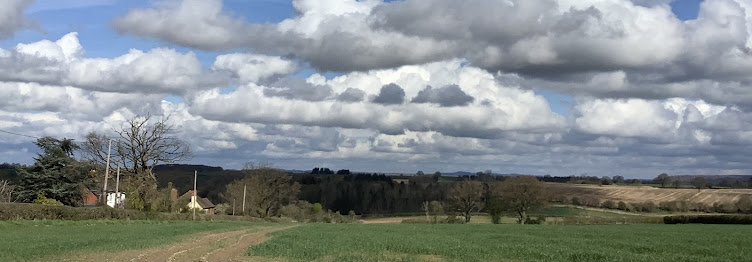
The bush in the left hand corner is in our garden and the strip inbetween is our neighbour's garden. It began in late spring, and our little old terrace of cottages shuddered and shook as the wrecking ball demolished the ugly 1960's retirement home which had previously stood there. All day, nearly every day (even at weekends) since then, we have lived with the accompanying noise of big diggers, industrial tools, shouting navvies, chainsaws, drills - well, the usual cacophony. So time in the garden has been infrequent and as needs be.


But despite all that, we've had a pretty good year. Picking funny little harvests and wondering how to bung it all together.


Eaten string beans when we wanted. Lots of them.


Custard squash were a triumph: what a great little vegetable they are - and when they are young, can be eaten skin and all. If you store them, then just cut them in half, roast them and scoop them out of their rind bowl.


Potatoes were meagre and very disappointing; we have had barely any rain here all year. I tried to keep them watered with my bucket - no hoses here - but it was a sparse result.


So the garden quietly slips into scruffy dishevelledness. A few things linger, thanks to the unseasonably warm weather, but it is time for a winter rest.


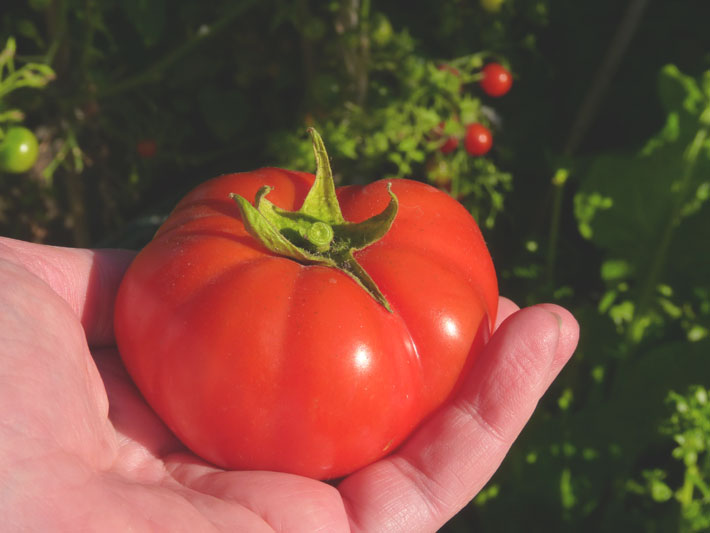
Oh, but tomatoes - the tomatoes excelled! The seriously cold snap must have killed off any blight we had lingering, and they have thrived.


All the plants are now stripped back to stalks and fruit. Despite a night's frost last week, the plants are still strong and healthy.


And I continue to pick ripe tomatoes in November, which is extraordinary.


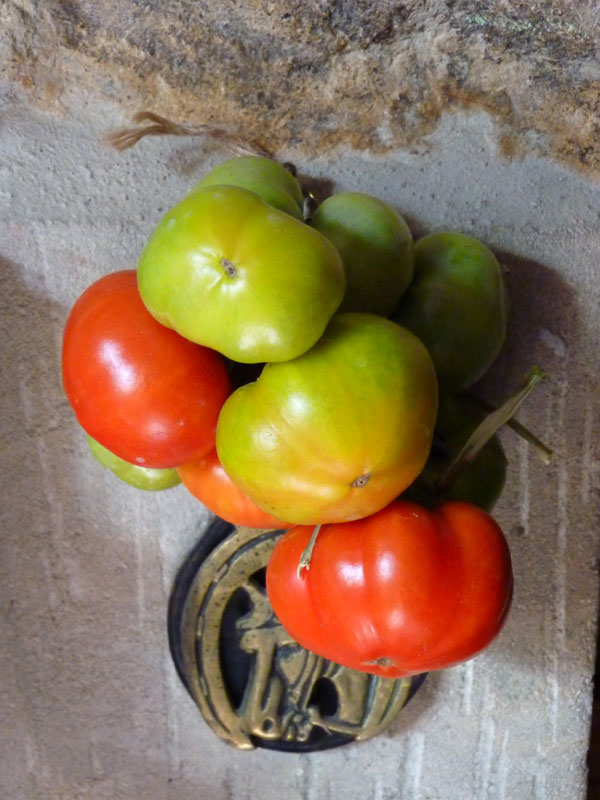
I also like to leave green tomatoes to gradually ripen indoors - they will last into late November at least, just left to hang.


We are still living next door to a building site, except that now some of the houses have been built - which means that this time next year, we will have new neighbours. The time to move has definitely come.


But at least I still have some last nasturtiums to enjoy.


30.10.11

Halloween treats


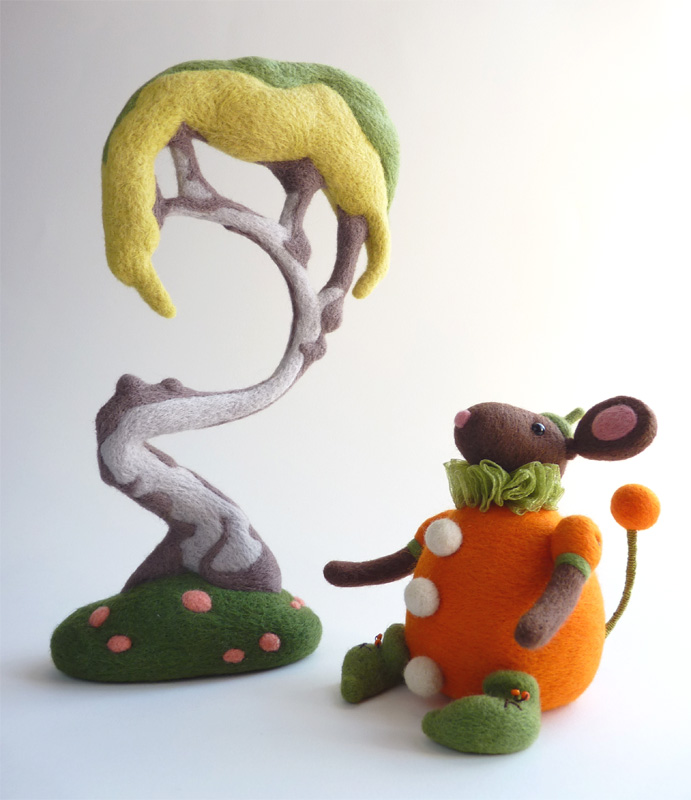
Earlier this month I went AWOL on my orders again and made a little Halloween mouse, who is already well settled in her new home. It was my first attempt at a ruff; much spitting and swearing (well, mild cursing anyway) ensued, as I fiddled about with unruly ribbon.


And then, just as I thought I'd cracked the perfect technique, I thought of a better way of doing it and had to re-do the whole thing again the next day.


But we got there in the end. Her head and arms are thread jointed and moveable.


The heart I always put on my toys was popped onto her tail end.


I like ruffs a lot and now that I've worked them out, they'll be making more appearances. I searched for the perfect name, and found a miniature type of pumpkin called 'Baby Boo' ,which was just right.


By happy coincidence, the kind person who was taking on my fat little Halloween mouse, also sent me an unexpected present, which arrived just as I was about to post her off. Photo opportunity of course!


My first and only Halloween decoration, a sparkly glass pumpkin half which is now dangling with my best treasures. (Thank you again to the gifter!)


And here she is in her new home, suitably surrounded by other festive decorations, saying hello to Griselda the goose witch - quite scary to think that I made her
two years ago.


Luckily Baby Boo had already left by the time this awesome hoard of American candy landed with a hefty thump on the doorstep - an incredibly generous box of sweets from lovely
Sooz, who knows that we like Dove Promises and Jellybeans and threw *just a few* more things in as well. Had Baby Boo found them she might not have been able to fit into her mailing box.


25.10.11

Headless Hare


Happily, this doesn't happen very often, but occasionally
I get halfway through a piece and realise that it is wrong to my original intention. As with this pre-ordered hare, Willow. Yesterday I realised that her arms were going to be too long for her body; cutting the arms down, as I did, didn't help. She needed more neck length. She was looking too tubby anyway - more like a rabbit than a hare. Only one thing to do...find the big scissors...
(If you are Janet of the Empty Nest, you might want to look away now...)


Cut off her head. It gives me a rare chance to look at cross section of one of my toys and see how densely it's been worked.


So the neck extending begins.


Once the wool is taking shape, I can hold the head on with a spare felting needle so that I can work on her more easily, in my hands.


About two hours after I cut her up, she is looking much better, but the joins are still weak and obviously showing.


So I tightly wrap some braces round the weak areas and needle them firmly -


- then carry on patching and smoothing. I also added more at her back, so that she didn't look too oddly tall.


After about five hours, I have a shape I am happy with and pop some black headed pins in her, so that we can say hello at last. Her proper glass eyes will be added later, but I like to have my toys looking at me while I work on them, so pins will do for now.


Much better - see the improvement? (You can look again now Janet).


20.10.11

Shorthand Sketches


I had reason to sift through my many Moleskine sketchbooks in search of little landscape roughs this week. I usually carry a pocket Moleskine around with me on my walks and often stop to scribble something down. It's never anything wonderful, just a form of shorthand, catching the design which I've spotted in a part of the landscape.


I understand my notes, though I don't know if anyone else would. Very often I'll draw them in a frame. Even though I've only started lino printing again recently, I've never stopped designing print ideas, knowing that one day I'd find time to recreate them. Some of them are very small indeed - this one below is about 5 cm/2" wide;


Sometimes I can *see* a whole colour print as I sketch and make notes accordingly.


Sometimes my notes come right out of my head and are so garbled that not many people except myself could work them out.


This one below is actually an idea for a decorative mount with corner vignettes - hot air balloon (really) in the top left corner, lost balloon in the top right, trio of trees bottom left and solitary house bottom right with winding path. It is the crudest of notes, but to me it makes perfect sense. Had I not quickly jotted it down, I would have forgotten all about it.


At other times - if I am waiting for something - like a bus - l can be painfully neat. All the observational drawing feeds into doing believable imaginative work.


These notes have turned into more stylised designs - it's like banking ideas for a future date.


Even if they start out quite realistic.


Here's a more natural sketch, but still making a feature of the curved frame the old beech tree trunks make.


I can often remember the exact moment I drew something, and what the weather was like, even if the sketch is many years old. These were drawn from life but with a definite view to make into lino prints.


I used to be painfully shy about my rough sketches, many years ago, but now I don't care what anyone else thinks - scribbles they may be, but their practical use is just a first step towards the finished product and for that reason, they are priceless to me.


12.10.11

Monsieur le Roitelet and the Birds


Nearly everything I buy comes from the internet; the village has a couple of food shops, but that's it for anything useful to me; I don't drive and what buses there are, are infrequent, expensive and take a long time to get from A to B. Buying something like good paper, which really needs handling, is a problem.

However, handily, there is a brilliant paper merchant
Paper Resources, literally just down the road from us. So in search of some really nice papers, I popped in to see them. Unlike a lot of paper suppliers, they are more than pleased to sell small amounts to individuals and the choice is fantastic; hence I emerged with a decent amount of gorgeous smooth, specialist papers, for about ten UK pounds, all handpicked by the merchant and myself, with much deliberation, including a wodge of hard-to-find Mohawk paper from the USA. Happiness!


So commenced another round of remembering how to print. Lino printing seems to be a bit of an ugly duckling in the art world - not regarded as sophisticated as etching, more akin to stamping or potato printing. However, there is a bit more to it than that. For a start, to get a really good, smooth print, the ink has to be rolled just so, the paper chosen to go with the ink viscosity and then the actual rolling of the ink onto the lino block is in itself a delicate operation, to get an even surface. I don't want edges on the print, so it mustn't be too thin or too thick.


That up above is a nice vintage Speedball brayer, which I was trying for the first time; I'm going to stick with it from now on as the roller is nice and densely soft, making the ink go into the block better than the harder rollers on my other brayers. I roll the ink out about an hour before using, to let it harden a little and get the right 'tack' - then it is rolled out thinly and again on a tray and then on a glass slab, until it starts making the right kind of light hissing noise. And only then it is carefully rolled onto the block, checking it from every angle to make sure that all areas are covered evenly. I look for a velvety surface like this;


To minimise ink getting where I don't want it, I use a mask while I'm inking up the block. The bed of the proof press I use has also been carefully raised up with various layers of paper and card, to get the depth of impression I want - even slipping a single sheet of newsprint underneath makes a difference.


And then yet another mask, for the actual printing.


The paper is held into place with a bit of tape, but I also like to hold it down lightly with my thumb as I make the first pull across, to stop slippage and misprinting.


I do two 'pulls' - quickly but carefully, not taking the roller off the paper, or it will slip minutely and give a double, blurred impression. It's a single, smooth movement and often goes wrong for me, with the first practise pulls. Here we go, with the first - the impression showing through.


And after the second pull. Now you can really see the deep indentation. Taking care to remove the paper so that you don't smudge anything, you peel the print from the block...


Breath a sigh of relief, as this time it came out well.


A now familiar sight in our little front room-cum-print-studio. Much has been discarded over the three hours of work and out of this lot, only a handful were deemed good enough to put in my shop.


Printed on the gorgeously smooth Mohawk Superfine heavy ivory paper, there are 14 copies of this printing of 'Monsieur le Roitelet and the Birds' for sale here at a princely £5.25/$8.

I'm really pleased to have managed that many, as it's a vast improvement on my other print runs and I think I'm getting back into the swing of it at last, after an 18 year break. Less bodge, more hurrahs.


If you are in or near Oxford, Simon of Paper Resources is going to be selling similar packs of paper at the Fine Press Book Fair on the weekend of 5/6 November at Oxford Brookes University, details here. I may well be going myself, to look up some old friends and seeing what's new.

(PS - There is a reason why my little man is called Monsieur le Roitelet, but I'll let you Google that one yourselves).