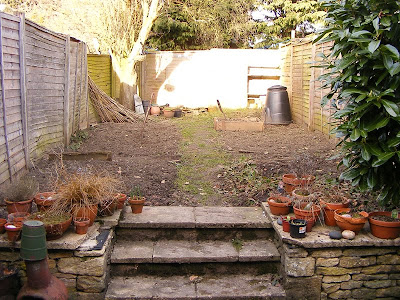
 A day off to catch up with things which need doing before the year runs away. The first really warm day of Spring and time to sort the garden out. It's a blank canvas to start with. Then we begin planting our chitted potatoes. First we sow two rows of 'Ratte' (right hand side) and two of 'Kestrel' with some blood and bone meal to give them a kick start. It is supposed to rain tomorrow, so we don't need to water them.
 My broad beans are doing well, but they can go in next week when the soil has had a good soak.
 Next *we* get to grips with putting up our new polytunnel - big, big thanks to Andy's mum and dad for such a generous Christmas present. Really it's just like putting up a big tent. Not my department, but remarkably easy. Apparently.

 As *we* busied ourselves, helicopters began humming overhead heralding the end of the first day of racing at the Cheltenham Festival and it felt as if this very long winter was finally over.
 We didn't realise it would be quite so big! It is 6.5 ft high, 6 ft wide and 14ft long. Our polytunnel came from here, but recently I have seen the same models for less, in sales. So I advise shopping around if you decide to invest in one.

Actually, it feels huge inside. It is three times as big as (what is laughingly described as) the cottage's kitchen. It's bigger than our bedroom. And it eats up a lot of the garden, especially once I had finished planting my potatoes, (Duke of York and King Edward) using most of the right hand bed.  Andy is circumspect about the amount of space it uses. I don't care. Inside there is lots of shelter for my darlings......things are coming up at last.
  Hopefully this year we might actually get some tomatos, which will be snug under cover and safe from the tomato blight spores which thrive in the damp winds of our wet British summers and have literally blighted us for the last few years. And there will be aubergines, courgettes, sweet peppers, chillis, perhaps even beans trained up the poles and arches. What joy it is to be a gardener - we have big dreams, hope for the best and expect the worst. In the end, it is usually something in the middle.
 For anyone wondering if I still make things, if I still needle felt, if I still paint - indeed I do; I do very little else at the moment, and am working very silly hours indeed. Things are getting somewhat stressful. I'm still bound by client confidentiality, so I will leave you to wonder what it is that is turning me into a nervous wreck.

This is the tale of two churches, the first, pictured here: the little church of Colne St Dennis, on a cold spring afternoon. It is Norman in origin, though probably built on the site of an earlier Saxon church. It is hard to believe that this wonky little building has managed to stay upright for hundreds of years; the original central Norman tower, built 850 years ago, was topped in the 1400's by a castellated belfry - that's the little square bit on top, with the flagpole on.

If you look closely you can see the older, more crumbling stone of the original tower underneath, and the walls bowing beneath the extra weight - yet it was propped up with a buttress or two and despite the sagging stones, it still stands.

This little porch is also a later addition from the 1600's.

We enter.

Inside, the older Norman entrance, with its patterned archway.

Despite its age, this church is still in regular use - oasis's and spare pots waiting for the next flower arranger.

The first recorded rector of this parish is the grandly named 'Henry de la More', 1272, several decades after the Battle of Hastings, ending with the more down-to-earth present day 'George Mitchell'.

The little human touches which remind us that this is still a much loved place - a worshipper's supply of mints awaiting them, in what must be their regular spot.

Looking down the aisle - the atmosphere saturated with the unmistakeable smell of English churches - damp stone mingled old, cold polished wood.


The pulpit, with a little heater to take the edge off the bitter cold winter mornings.

Leaving the church, and passing the usual poignant reminder of the great sacrifice made by countless tiny villages all over our country - often a whole generation of young men wiped out. We never, ever forget to stop and think of them. Listed here is a 'C.H.L Bubb', the same surname as the serving rector at the time (Lewis Bythesea Bubb) and probably his son. The Day family lost three members.

We carry on down the lane, stopping to look back.

Andy discovers an old clay pipe, hidden in the wall. A long time ago, someone stood here to have a smoke and look at this very scene, pretty much the same then as it is now. There are still hard, black charred remains in the barrel. Maybe they were related to one of the men listed in the roll of honour we had just read.

We walk across to nearby Coln St Rogers, to investigate the Saxon church, seen here nestling in the landscape, the tale of which continues here...


My only (temporary) disappointment with our recent visit to the Ashmolean was the disappearance of the Samuel Palmer drawings. I remembered them being in a glass topped display cabinet, covered with aged green velvet covers, which one had to lift in order to worship these little masterpieces.  I can't remember the first time I discovered Palmer's work, but I am sure it coincided with my arrival in Oxford. I do remember an instant connection with his pastoral scenes and unlike some of my other early mentors, he has remained a firm favourite.
In the end we went to the information desk and were told that the drawings were now in the Print Room; would we like to see them? By now we'd been traipsing about for three hours and our eyes were on stalks, but it was too good an offer to refuse. Within five minutes we were reverently examining six of Palmer's most popular works, which I am sure many people will instantly recognise.
 The light was such that flashless photos (allowed) did not come out terribly well ; but the nature of Palmer's technique - thick lines of inks and gums combined with washes - means that even professional reproductions are not true to the originals; the raised surfaces can be just detected even in the postcards sold in the museum shop. Here they glint with a blue-ish hue.
 Another thing a postcard does not really capture is the exquisite detailing - everywhere there are points of interest and captivating little scenarios. These works were created when Palmer was still young. He seems to have had a fairly difficult life, losing his mother when he was thirteen, which seems to have coincided with his decision to become an artist; somewhat parallel to my own experience.
  For me, these are his best works, created when he was only twenty and in one of what must have been one of the happiest periods of his life, when he lived at Shoreham, surrounded by like-minded young visionaries inspired by William Blake and a romantic, nostalgic yearning for a simpler, rustic life. Familiar as I am with these artworks, I still found new things to delight, such as the tiny focal points, which lead the eye beyond the foreground to miniature landscapes and the hint of lands beyond. Most of all, it reminded me of the tiny patches of the Cotswolds which still retain their pastoral beauty.
 At last we remembered more prosaic things - our tired feet and that it was past lunchtime. We said a fond farewell to Samuel Palmer and swiftly headed to the Three Goat's Heads, one of the best pubs in Oxford, and a meeting with another Samuel. A pint of Samuel Smith's Imperial Stout, a welcome, if earthy comedown from our artistic wanderings.
 The Ashmolean Museum, Oxford
 Suffering from what I now know was deep depression, the result of a chaotic childhood, traumatised by losing one parent after another, I was in a downward spiral, common to youngsters who are dumped by the care system and left to sink or swim. It was a hopeless situation, but at least I finally had the wit to realise that. So I was heading to Oxford for an interview to get onto an A level art course, at the more humble College of Further Education.
 We were dropped off at the Abingdon Road roundabout and immediately a summer shower drenched us. We walked up to St Aldates. The sun came out. It was my first glimpse of Cotswold stone, and the wet buildings glowed golden yellow. Almost on cue, the bells of Oxford began to peal, as if welcoming me - it was a million miles away from the damp, slummy bedsit we had left behind us and I could actually sense the course of my life changing. I fell irretrievably in love with this ancient, beautiful city and it, in turn, civilised me.
I got my cherished place at the college and began the long, slow process of repairing my fractured life. I also began studying art history, and after so many years of neglect, my starved soul guzzled up knowledge and culture. I discovered the Ashmolean - like so many of our museums, it was and is, still free admittance to everyone. I nourished myself on paintings, largely ignoring the artifacts sections, which interest me now. With my battered Penguin copy of Vasari's Lives of the Artists in my pocket, I drew bronzes and copied artworks to my heart's content. I haunted the Renaissance room, which looks almost the same today as it did then. I haven't been there for years - it is a fair trek to town if you do not own a car, so outings are rare. But this week we made the effort, to see the new gallery extension, opened last November. I was a little fearful of how they had treated the old girl, and raced up to the Renaissance room to say hello to my old friends.

After this comfort trip, we found our way almost by accident, to the new development, which cost £61 million...and worth every penny. It is stunning - it actually brought tears to my eyes. We wandered about gawping at the luxurious and clever use of space - a cross between a glass ants nest and the drawing 'Relativity' by Escher. The place was buzzing - a strange change from the previous fusty atmosphere, but a welcome one; it really felt like a 'people's museum'. 

 I fell in love all over again, and realised how much I had missed actually seeing real artworks of quality. There were dozens of enthusiastic, helpful staff buzzing about (a radical change from the grumpy jobsworths who used to sit foursquare in a corner, dozing off) and I enthused to one young lady about the new extension, explaining how I used to come and draw here, thinking I would be the next Michelangelo. She asked me if I did go on to become an artist, and I said yes, I'm a children's illustrator; not exactly what I had in mind then, but I did achieve some of my dreams.

I am in absolute denial that Spring is not coming. Last Sunday's walk felt like the turning of wintertide, and to celebrate, I planted our vegetable seeds.
 Sticking to what we know grows best for us; three types of squash, including the Boston Marrow that Libby Buttons send me from America. Courgettes (which my US friends called zucchini) Cucumbers, Rosemary, a squadron of them, to nullify the pain of losing my old timers during the snow. Basil, to pretend that we may, one day, have summer. Tomatos and some long sweet peppers that might not come up as they are a little out of date. And broad beans for some early crops.
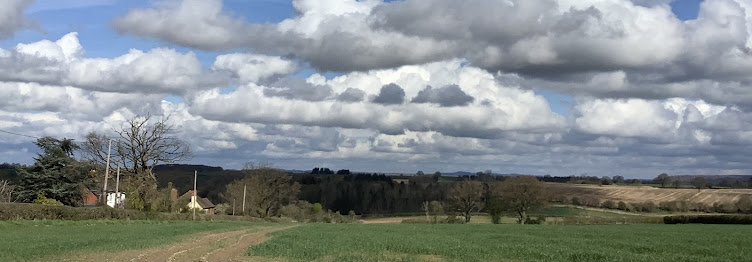
 Then the weather played spiteful tricks and we have had snow again. Today we dutifully marched across muddy fields for some fresh air and exercise. We were not the only ones waddling down the footpath.
 But we could not fly away like this -
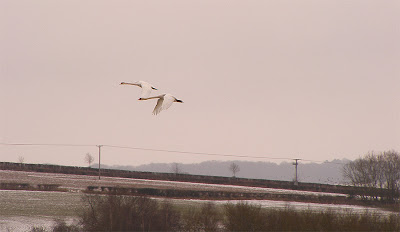 Or land with such perfect synchronicity.

 I have been completely wrapped up with the next stages of my two jobs. and trying to juggle them. One of them has already used up an entire A3 sketchbook. I enter the studio, start work, and with a few mental breaks for Twitter and Facebook (hey, I don't take lunch breaks!) - I am working for 8-9 hours at my desk at things I may not reveal - yet. This is not going to change until July, so I will have to find something else to talk about or I will turn into a silent bore.
Let me show you our first baby.

 A day off to catch up with things which need doing before the year runs away. The first really warm day of Spring and time to sort the garden out. It's a blank canvas to start with. Then we begin planting our chitted potatoes. First we sow two rows of 'Ratte' (right hand side) and two of 'Kestrel' with some blood and bone meal to give them a kick start. It is supposed to rain tomorrow, so we don't need to water them.
 My broad beans are doing well, but they can go in next week when the soil has had a good soak.
 Next *we* get to grips with putting up our new polytunnel - big, big thanks to Andy's mum and dad for such a generous Christmas present. Really it's just like putting up a big tent. Not my department, but remarkably easy. Apparently.

 As *we* busied ourselves, helicopters began humming overhead heralding the end of the first day of racing at the Cheltenham Festival and it felt as if this very long winter was finally over.
 We didn't realise it would be quite so big! It is 6.5 ft high, 6 ft wide and 14ft long. Our polytunnel came from here, but recently I have seen the same models for less, in sales. So I advise shopping around if you decide to invest in one.
 Andy is circumspect about the amount of space it uses. I don't care. Inside there is lots of shelter for my darlings......things are coming up at last.
  Hopefully this year we might actually get some tomatos, which will be snug under cover and safe from the tomato blight spores which thrive in the damp winds of our wet British summers and have literally blighted us for the last few years. And there will be aubergines, courgettes, sweet peppers, chillis, perhaps even beans trained up the poles and arches. What joy it is to be a gardener - we have big dreams, hope for the best and expect the worst. In the end, it is usually something in the middle.
 For anyone wondering if I still make things, if I still needle felt, if I still paint - indeed I do; I do very little else at the moment, and am working very silly hours indeed. Things are getting somewhat stressful. I'm still bound by client confidentiality, so I will leave you to wonder what it is that is turning me into a nervous wreck.


